
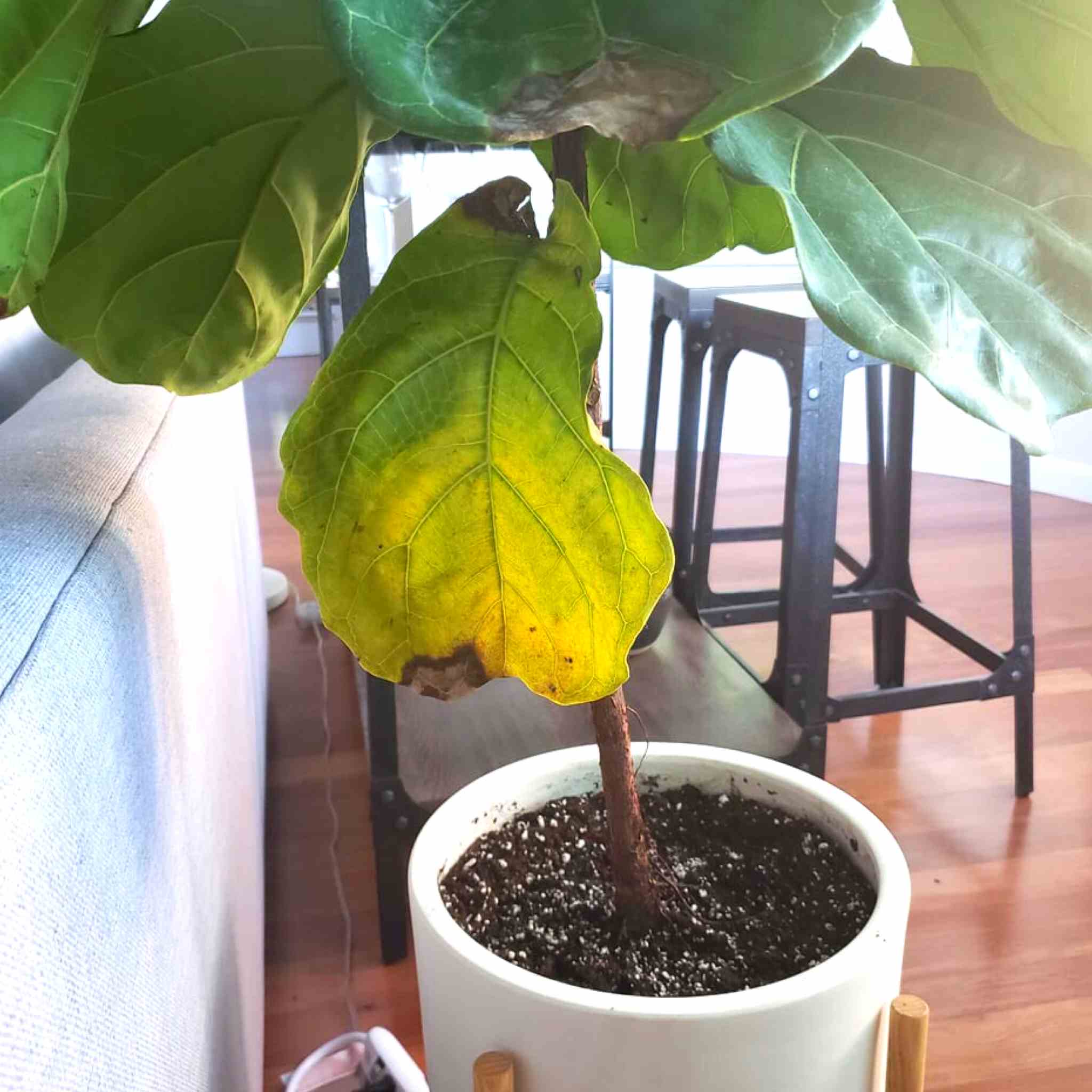
If your fiddle leaf fig leaves keep turning yellow at the edges and you’re not sure what’s going wrong then you’re not alone. Fiddle leaf figs can be a bit dramatic and yellowing leaves are some of the most common ways to show you they’re not happy.
The first time my fiddle leaf fig started dropping yellow leaves, I panicked. I watered it more (which was the wrong thing). I moved it. I even tried talking to it!
The problem is that yellowing can mean a a whole host of different things. And guessing wrong just makes things worse.
Thankfully fiddle leaf fig leaves turning yellow is almost always something you can fix once you know what you’re dealing with. In this guide I’m going to take you through the 7 most common reasons it happens, how to tell them apart and what to do about each one.
How to Tell What’s Wrong With Your Fiddle Leaf Fig
Before looking at individual causes it’s worth taking some time to take a closer look at your plant. The pattern of yellowing – where it appears, how fast it spreads, which leaves are affected – tells you a lot about what’s going on.
Ask yourself a few quick questions:
- Is the yellowing happening on older leaves near the bottom or newer leaves at the top?
- Are the yellow patches getting bigger from the centre of the leaf or are they appearing along the edges?
- Did the yellowing start after you moved the plant, repotted it or changed your watering routine?
- Are you also seeing spots or brown edges with the yellow?
These details matter because a fiddle leaf fig with overwatering problems looks quite different from one that is deficient in nutrients – and treating the wrong thing won’t help but might make things worse. Keep this in mind as you read through the causes below.

7 Reasons Fiddle Leaf Fig Leaves Turn Yellow
1. Overwatering
If there’s one thing that kills more fiddle leaf figs than anything else it’s overwatering. And the tricky part is that overwatering doesn’t mean giving the plant too much water in a single session – it means watering too often before the soil has had a chance to dry out.
When the roots sit in consistently wet soil they can’t get oxygen. They start to break down.
The leaves then don’t get enough nutrients because the roots can’t absorb properly, so they begin to turn yellow – often from the bottom of the plant moving up and starting with older leaves.
What to look for: yellowing on lower, older leaves first. Soil that feels wet or even slightly soggy an inch or two down when you stick your finger in it. Possibly a slightly musty smell coming from the soil.
What to do: Stop watering straightaway and let the soil dry out completely. For most fiddle leaf figs this means watering roughly every 7 to 10 days in the summer and even less in the winter – but always check the soil first. Before every watering push your finger down 2 inches in the soil. If it’s still damp, wait.
A good rule of thumb is to water thoroughly when the top 2 inches of soil are dry, let the water drain fully through the pot and never let the plant sit in a saucer of standing water.
2. Root Rot
Root rot is what happens when overwatering is left unchecked for too long. It’s caused by fungal pathogens that love waterlogged conditions and begin to rot the roots from the outside in.
I once repotted a fiddle leaf fig for a friend. When we lifted it out of the pot at least half of the roots were brown, mushy and smelled awful. She’d been watering it twice a week, every single week, regardless of the season or the condition of the soil.
Root rot causes yellow leaves that often also have brown patches that can be mushy too. The yellowing tends to be widespread and moves fast – you’ll notice more than one leaf affected at once. In serious cases the lower stem can start to look soft or brown near the soil line.
What to do: Take the plant out of its pot and look at the roots. Healthy roots are white or tan colored and will feel firm. Rotten roots are brown, black, slimy and soft. Trim away all the diseased roots, dust the cuts with some cinnamon (a natural antifungal) and repot into fresh, well draining soil. Make sure your pot has drainage holes too.
Recovery is possible but it will take time. Don’t overwater again while the plant is recovering and resist the urge to fertilise the plant until you see new healthy growth.
3. Underwatering – Less Common, But It Happens
Sometimes in the rush to avoid overwatering some people go too far the other way. Fiddle leaf figs do need consistent moisture.
Letting them dry out completely and stay that way for long periods of time will also cause yellowing, just with a slightly different pattern.
Underwatered fiddle leaf figs tend to show yellowing that starts at the tips and edges of the leaves before eventually progressing to the center. The leaves may also feel dry, curl a bit or become crinkly. The soil will be bone dry too.
What to do: Water it thoroughly, allowing water to run all the way through the drainage holes. If the soil has become so dry the water runs straight through without being absorbed then try bottom watering. That means putting the pot in a container of water for 30 to 45 minutes so the soil can slowly absorb the water from the bottom up.
Try to find a consistent rhythm. Fiddle leaf figs like routine – watering at erratic times and where the plant swings between very dry and soaking wet, stresses them and makes yellowing much more likely.
4. Poor Drainage or Wrong Soil Mix
This is often gets overlooked because people focus on watering frequency without thinking about what happens to the water after it goes in. Even if you’re watering at exactly the right time and your soil doesn’t drain properly your fiddle leaf fig will essentially be sitting in wet conditions regardless.
Standard potting mix, on its own, often retains too much moisture for a fiddle leaf fig. In nature fiddle leaf figs grow in well draining hillsides in the rainforests of Africa, not in waterlogged lowlands. Their roots need air as much as they need moisture.
Signs of poor drainage: water pools on the surface before slowly sinking in or the soil still feels wet 5 to 7 days after watering. Yellow leaves that don’t seem to make sense with overwatering patterns.
What to do: Repot into a mix designed for good drainage. A solid fiddle leaf fig soil mix is roughly two parts peat free potting compost, one part perlite and one part orchid bark or coarse sand. This gives the roots the air flow they need. Make sure any pot you use has at least one – ideally several – drainage holes.
 Fiddle Leaf Fig Soil by Perfect Plants 8QTS, Premium Professional Blend for All Fiddle Leaf Figs
5. Nutrient Deficiency
A yellowing fiddle leaf fig isn’t always a watering problem. Sometimes the plant is perfectly watered and drained but just isn’t getting the nutrients it needs.
The two most common nutrient deficiencies in fiddle leaf figs are nitrogen deficiency and iron deficiency. Nitrogen deficiency tends to cause a yellowing that starts with the oldest, lower leaves and slowly works its way up.
Iron deficiency looks a bit different – you’ll see yellowing between the veins of new, younger leaves while the veins themselves stay green.
Nutrient deficiencies are especially common in plants that haven’t been repotted in a while (the nutrients in potting mix get depleted over time), or in plants that have been overwatered as waterlogged soil stops nutrients being taken up even when the nutrients are present.
What to do: During the growing season (spring through early autumn) feed your fiddle leaf fig with a balanced liquid fertiliser – look for something with an NPK ratio that has a good amount of nitrogen, like a 3-1-2 ratio. Products formulated specifically for fiddle leaf figs exist and are worth using as they’re made for the plant’s specific needs. Fertilise every month in spring and summer; stop altogether in winter when the plant isn’t actively growing. Don’t fertilise a stressed or recently repotted plant.
If you suspect iron deficiency is the problem then a foliar spray with chelated iron can help the plant absorb iron more effectively, especially if your tap water is very alkaline (high pH stops iron uptake even when it’s in the soil).

6. Too Little Light – Or the Wrong Kind
Fiddle leaf figs are what I’d describe as high maintenance when it comes to light. They want a lot of it – bright, indirect light for most of the day – and they will absolutely let you know when they’re not getting it. Yellowing is one of their main complaints.
In low light conditions fiddle leaf figs can’t photosynthesize properlt. Chlorophyll production drops.
The leaves go yellow – usually starting with older leaves that are furthest from the light source – and the growth slows or stops entirely. The plant is just surviving at this point.
Direct sunlight is a different problem – too much harsh, direct sun (especially through south facing windows in the summer) can burn the leaves, causing yellowing with brown patches, particularly on leaves nearest to the glass.
Fiddle leaf figs grow best in bright indirect light of around 200 to 400 foot-candles. To put that in perspective a spot a few feet back from a large east or west facing window is usually ideal.
North facing rooms are generally too dim. South facing windows can work if the plant is a bit back from the glass.
What to do: Move your plant closer to a bright window if it’s been sitting in a corner with little light. If your home is dark then a full spectrum grow light can make a real difference – 12 to 14 hours of supplemental light per day is a good amount.
 LBW Grow Lights for Indoor Plants with Stand, 642 LEDs Full Spectrum Standing Grow Light
And once you’ve found a spot your fiddle leaf fig likes – leave it there. They really hate being moved around and will often drop leaves as a result.
7. Environmental Stress
Fiddle leaf figs are incredibly sensitive to changes in their environment. A sudden drop in temperature, a draft from an air conditioning vent or open window, being put near a radiator or even being moved from one room to another – all of these can trigger yellow leaves and leaf drop.
The yellow leaves from environmental stress often appear quite quickly – within a few days of the stressor – and are scattered rather than following any sort of pattern. You might lose leaves from different parts of the plant at random.
Fiddle leaf figs like temperatures between 60°F and 85°F (16°C–30°C) and don’t tolerate temperatures below 55°F (13°C). They also don’t like dry air – indoor humidity below 30 to 40% can cause leaf stress. This is especially worth paying attention to in the winter when our central heating dries out the indoor air significantly.
I brought a new fiddle leaf fig home last January, put it near a window that turned out to have a draft and it lost five leaves in two weeks. The moment I moved it to a wall away from the window it stopped dropping.
What to do: Check where your plant is sitting. Is it near a heating vent, radiator or air conditioning unit? Is it by a window that gets cold at night? Is it being moved around a lot? Try to find a stable spot with consistent temperature. If your home is dry then a small humidifier nearby – or even grouping your plants together – can help raise the humidity. Try not to mist directly on the leaves as this can result in fungal issues.
 Levoit Top Fill Humidifiers for Bedroom, 2.5L Tank
What to Do When You’re Not Sure What’s Wrong
Sometimes the yellowing doesn’t fit neatly into one category. Maybe the light is fine, the soil seems okay and you’re pretty sure you haven’t been overwatering it but the leaves are still going yellow.
In that case you’re going to have to go back to basics and check everything:
- Check the roots. Take the plant out of its pot and have a proper look at it. Even if you’re not sure what root rot looks like brown and mushy is a clear sign.
- Check your water. Tap water with high chlorine or fluoride in it can cause yellowing over time. Try using filtered water or leaving tap water out overnight before using it.
- Check for pests. Spider mites, scale insects and fungus gnats can all cause yellowing by stressing the plant. Look under leaves and near the top of the soil.
- Check how long it’s been since you repotted. If it’s been more than 2 years then the nutrients in the soil are likely to be depleted and the plant may be root bound.
Fiddle leaf figs often have a few yellow leaves as part of normal life – especially older leaves as the plant grows. One or two yellow leaves is not necessarily a crisis. A pattern of yellowing, spreading or repeatedly losing leaves is when it’s worth looking at more closely.
Fiddle Leaf Fig Leaves Turning Yellow: Quick Reference
If you want a quick cheat sheet this is what to look for and where:
- Yellow lower/older leaves, wet soil: Overwatering
- Yellow leaves + brown mushy patches + bad soil smell: Root rot
- Yellow leaf edges, dry curling leaves, bone dry soil: Underwatering
- Uniform yellow across whole plant, slow growth: Low light or nutrient deficiency
- Yellowing between veins on new leaves: Iron deficiency / chlorosis
- Rapid leaf loss, no clear pattern: Environmental stress (drafts, temperature, relocation)
Final Thoughts
Get the watering right, give the plant bright indirect light, keep it away from drafts, and feed it through the growing season and that should cover about 80% of what goes wrong.
If your fiddle leaf fig leaves are turning yellow don’t panic and don’t just start guessing randomly. Look at the pattern.
Check the soil. Check the roots if needed. Work through the causes one by one.
