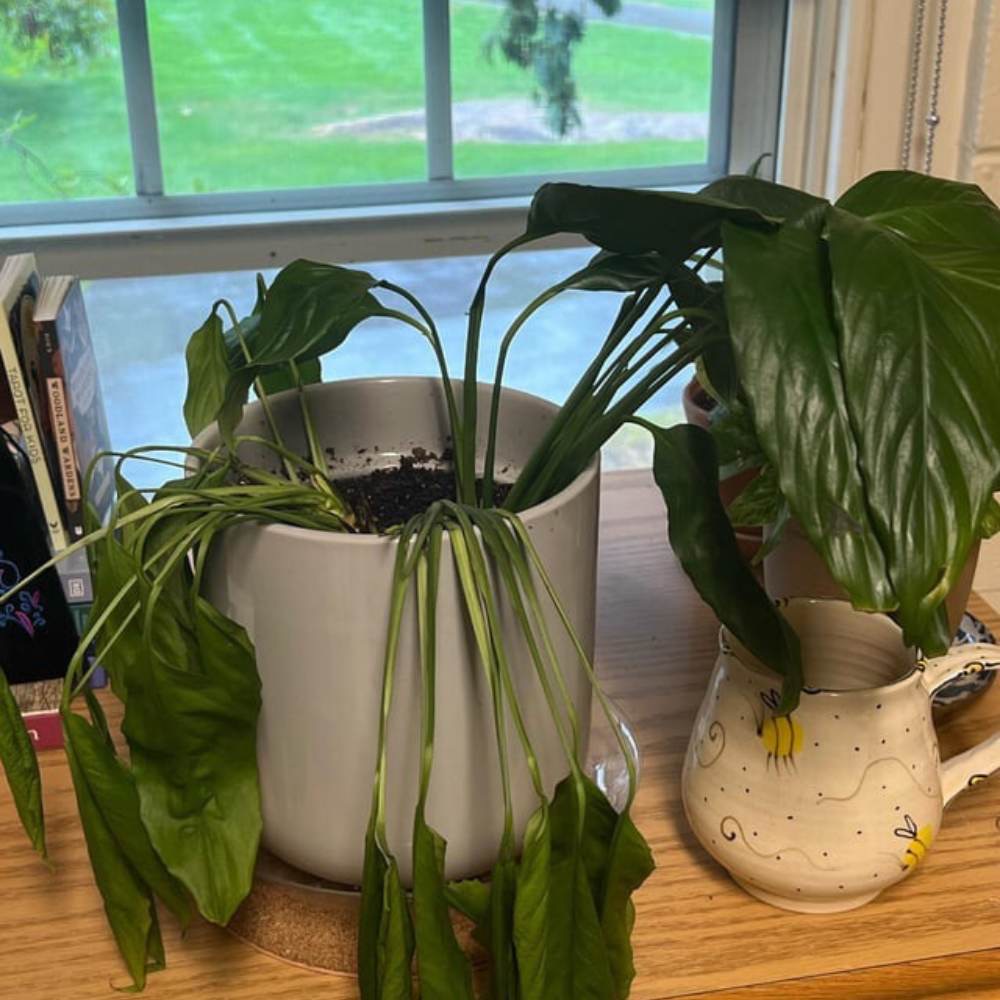
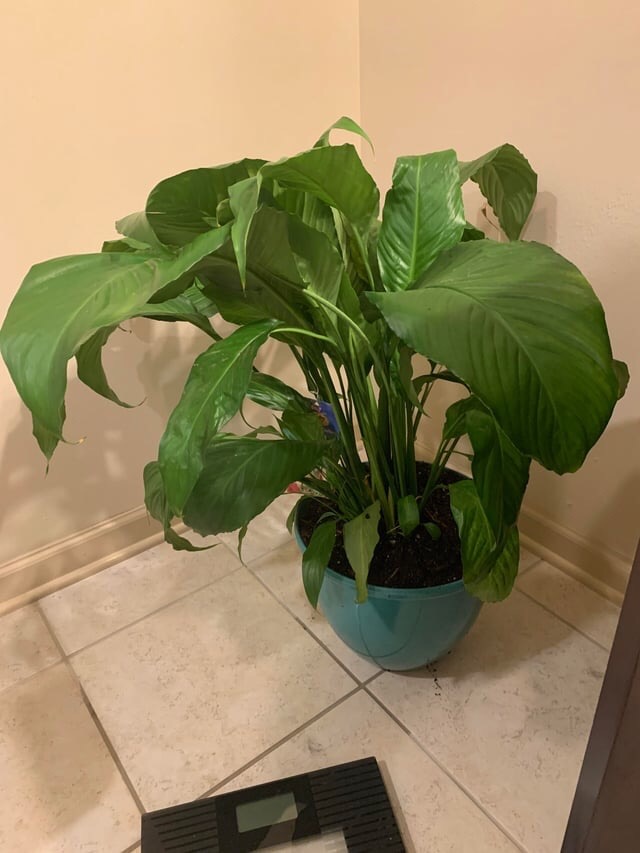
A peace lily that is leaning to one side or growing unevenly is telling you something. Leaning is a symptom that you should pay attention to before whatever is going on get worse.
If you ignore a small lean for a few months it can become a major problem and in some cases the lean is a sign of a bigger issue that will cause much even more problems if you don’t do something to fix it.
But there are a few different things can cause a peace lily to lean, which makes it a bit trickier to diagnose what’s going on. And the right response depends on identifying which one you are dealing with.
A plant leaning towards the light needs to be rotated, not staking. A plant leaning because of root rot needs root treatment, not a brighter window. So getting the diagnosis right before you take action is the difference between fixing the problem and just making it worse.
That’s where this guide comes in. I’ll take you through the seven most common reasons a peace lily leans, with a diagnosis section for each that tells you how to identify what’s causing it and a fix section to show you exactly what to do about it. Work through the reasons in order – starting with the most common – and you will find your answer.
Phototropism is the tendency of plants to grow toward light and it is the most common reason a peace lily leans. Plants produce auxins, which are growth hormones, and they build up on the side of the stem that’s in the shade. This will cause the cells on that side to get longer than the cells on the lit side.
The result is a stem that curves, or leans, towards the light. If you’ve got a peace lily that has a window to one side of it then the leaning will develop slowly and progressively until you can see a very obvious lean to the direction of the window.
This isn’t a sign that anything is wrong with the plant. It’s actually totally normal and healthy biology.
But it does make the peace lily look lopsided. And most people want to correct it so it looks more symmetrical.
If it’s left unchecked it can cause the plant’s centre of gravity to shift far enough that the whole pot will become unstable.
How to diagnose it: The lean is consistent in one direction – the plant leans toward one specific side which is the side that gets more light. All or most of the leaves are facing and leaning in the same direction. The lean comes on gradually rather than appearing suddenly. The plant is otherwise healthy – the leaves are a good color, no yellow or spotting, growing normally. There is a clear light source (window, grow light, skylight etc.) in the direction the plant is leaning towards.
What to do: Rotate the plant. Turn the pot about a quarter turn so the side that was facing away from the light is now facing towards it. The plant will gradually begin to lean back and straighten up over the following weeks as the new side begins to get more light. For a plant with a significant and longer term lean the correction will take time – sometimes several months before the plant is fully upright again. Keep rotating it a quarter turn every two to four weeks from this point on. This stops the lean from coming back by making sure all the sides of the plant get about equal light over time. Moving the plant to somewhere it gets light from above or from multiple directions – beneath a skylight or under a grow light thats overhead – will stop the light source from only one direction that causes phototropic lean entirely.
Using a stake for phototropic lean: Staking a plant to correct a lean is treating the symptom rather than the cause. The plant will continue to grow toward the light and the lean will persist or worsen despite the stake. Rotate it first and only stake it if the lean is severe enough that the plant is at risk of toppling over while the rotation helps to correct the direction of growth over time.
A peace lily that has been overwatered for a long time will develop root rot, and roots that are rotting can’t support the plant’s stems with the same way healthy roots would do. The stems lose some of their support and begin to droop or lean, particularly the larger and heavier outer stems that rely most on the roots being anchored to stay straight and upright.
This is one of the more serious causes of leaning because it show a big problem rather than simply an issue with where the plant is placed.
How to diagnose it: The lean appeared gradually alongside other symptoms of overwatering: yellow leaves (particularly the lower leaves), soil that stays wet for more than a week after being watered, a nasty smell coming from the soil or wilting that happens even when the soil is moist. The lean is not going towards light – the stems lean in various directions or droop generally rather than toward one side. Take the plant out of its pot: if the roots are brown, soft or hollow rather than white and firm you can be sure it’s got root rot.
What to do: Fix the root rot. Remove the plant from its pot and look at its roots. Cut away all the soft, brown or mushy roots until there is only healthy, white tissue. Dust the cut surfaces with powdered cinnamon to stop the fungus spreading any more. Let the roots dry out for an hour before repotting the plant in fresh, well draining compost in an appropriately sized pot. Don’t water for five to seven days after repotting. Resume watering conservatively – only when the top inch or two of compost is dry – and make sure the pot has enough drainage holes and the saucer it sits in is emptied after each watering. As the roots recover and begin to function properly again the stems will gradually grow more upright and straighten. Very severely damaged roots may mean some outer stems never fully recover. If this is the case then remove the most affected outer stems at the base so the plant can focus its energy on the healthier inner growth.
When a peace lily is in very low light – not just less than ideal light, but properly low where it can’t photosynthesize fully – the plant produces etiolated growth. Etiolation is when a plant stretches its stems and leaves in an attempt to reach more light, which results in growth that is taller, thinner and weaker than growth that would happen with the right amount of light.
Etiolated stems aren’t as rigid as well lit stems because the plant is sending its resources toward elongation instead of thickening the cell walls. This ends up with stems that can’t support their own weight and droop or lean despite the plant being otherwise fine.
How to diagnose it: The leaves look pale or washed out rather than a glossy green. New leaves will grow smaller than established ones, and the stems between leaves are longer than they should be – the plant looks stretched and leggy rather than compact and full. The plant is in a low light position: a few feet from any window, in a room with small windows or in a direction that receives very little daylight. The lean is general instead of going specifically towards one source of light – the plant looks weak and floppy throughout rather than leaning in one direction.
What to do: Move the plant to a brighter spot with bright indirect light – close enough to a window that you could comfortably read a book by natural light where the plant is. Do this gradually rather than all at once if the plant has been in very low light for a long time; leaves that are used to less light can be bleached or burnt by suddenly being moved to much brighter light. Move it partway first – to a medium light spot – for a week or two before moving to the final bright position. The etiolated stems that are already present will not get thicker and straighten but new growth thats comes from better light will be compact and stronger. Over time, as the plant produces healthy new growth and you remove the weakest etiolated stems, the plant will get more and more straight and upright. A grow light on a timer, used overhead, is a great solution for spaces where there is no good spot with natural light available.
Reason 4: Uneven Watering or Soil Moisture Distribution
04 Roots developing more strongly on one side of the pot
This is a more subtle cause of leaning that is often overlooked. If you’re watering on only or mostly one side of the pot, like if you always pour from the same side, or if the drainage is better on one side of the pot than the other due to whete the drainage holes are – the roots develop more strongly on the side that gets more moisture.
The more developed roots on that side anchors the plant firmly while the less developed side gives the plant less support, causing it to lean away from the stronger root side over time as growth weight is unevenly supported.
How to diagnose it: The lean happened gradually with no obvious trigger (no change in position, no obvious light in the direction it’s leaning). Watering has been consistently on one side of the pot rather than evenly across the soil. The soil feels drier on one side of the pot than the other when you check with a finger at different points around the edge. The lean is not towards light – in fact it may be away from the main light source, which rules out phototropism as the cause.
What to do: Change your watering technique to distribute the water evenly across the while of then soil – pour slowly in a circular pattern around the pot rather than all in one spot. Bottom watering is a great solution for this issue too: put the pot in a tray of water for 20 to 30 minutes and let the compost absorb the moisture evenly from below. Consistent bottom watering make sure the all the roots get equal water and gets rid of the uneven root development that caused the lean. Rotate the pot a quarter turn at each watering to encourage even root and stem development. The plant’s lean will correct gradually as the roots on the underserved side develop to match the stronger side.
This is a cause that surprises people because they think that more roots means more stability. But a peace lily that has completely filled its pot with a lots of roots faces the opposite problem: the roots have become so tightly packed in the pot that they have lost their ability to anchor the plant.
The root ball becomes rigid and circular – it holds its pot shape rather than spreading to support the stems. Meanwhile the plant has been growing taller and wider above the pot and the top heavy of leaves and stems have more leverage than the root ball. The result is a plant that rocks and leans, mostly towards the heavier side.
How to diagnose it: The plant is noticeably large in relation to its pot – the spread of the leaves is much bigger than the diameter of the pot, making it too heavy. Roots are coming out of the drainage holes. The pot dries out very quickly after watering – within a day or two – because there is almost no compost left when compared to the roots. When you try to straighten the plant by adjusting the position of the stems it just settles back into the lean relatively quickly. Take the plant out and what you see is a pot shaped mass of roots with very little compost.
What to do: Repot it into a pot one size up – usually 5cm (2 inches) bigger in diameter than the current pot. Before repotting pull apart the outer roots to encourage the roots to spread into the new compost rather than continuing to grow in a circle. Use a well draining houseplant compost and make sure the new pot has enough drainage holes. After repotting the expanded roots in the bigger pot will have be better anchored and the lean should resolve itself within a few weeks as the roots establish in the new compost. If the plant is very large then staking it temporarily while the roots get established in the new pot is a good idea – but the stake is a support while repotting takes effect, not a long term solution.
Reason 6: Physical Damage or a Weak Crown
06 Structural damage to stems or the crown
A peace lily that has been physically damaged – knocked over, had a stem bent, a person or door repeatedly knocking up against it, or been handled roughly when it was repotted – can develop a lean that comes from the point of that physical damage. A stem that has been partially kinked or bent at the base does not go back to being fully straight and if the damage is at the crown (the central point where all stems grow from) the whole plant may lean as a result of the crown being set at an angle rather than level.
How to diagnose it: The lean appeared relatively suddenly rather than gradually and you can figure out a specific event that preceded it – the plant was knocked over, moved roughly, had something fall on it or was repotted. Look at the stems at the base: a stem with a kink or bend will show a slight discolouration or soft point at the spot where it was damaged. The lean comes from one specific stem or from the base of the plant (the crown) rather than from multiple stems. If the crown is set at an angle in the pot the whole plant leans even if no individual stem is damaged.
What to do: For a single damaged stem: if the stem is still functional (leaves are not wilting or yellow and the damage is superficial), support it with a small stake and let it recover. If the stem is severely kinked and the leaves above the kink are dying remove the stem at the base – the plant will send it’s energy to other stems and give you new growth from the crown. For a crown set at an angle: carefully unpot the plant, put the root ball in the pot so that the crown is level with the surface of the soil and in the center of the pot and repot it in fresh compost. Gently firming the compost around the repositioned root ball while checking the crown is level will stop the lean at its source. Let the repotted plant settle for two to four weeks before seeing if the correction has held.
Reason 7: Unequal Growth and Natural Asymmetry
07 One side of the plant simply growing more than the other
Peace lilies, like all plants, do not always grow perfectly symmetrically. Different sections of the roots and crown may be more active than others, which will mean more stems and larger leaves growing from one side of the plant than the other.
When one side is significantly denser and heavier with growth than the other the pot tilts or the plant leans toward the heavier side under its own weight. This is the most benign cause of leaning – its really a sign of a healthy and actively growing plant – but it can become a problem if the asymmetry is significant.
How to diagnose it: The plant is healthy in all other respects – leaves look good, growing well, being given the right water and light. The lean is down to the side of the plant that has more leaves, bigger leaves or denser growth. The other causes on this list have been ruled out: there is no clear single light source in the direction it’s leaning, the roots are healthy, the soil is moist enough, the plant is not severely root bound, there has been no damage to it and the light is right. The lean is toward the heavier side rather than toward the light.
What to do: There are three approaches to this depending on how severe it is. First, rotate the pot regularly so that the lighter, less dense side gets more light, encouraging it to grow on the side that balances the heavier part over time. Second, you might want to remove one or two of the largest, heaviest outer stems from the denser side to redistribute the weight – these stems can be propagated if they are healthy. Third, repot the plant into a slightly wider, heavier pot that has a lower centre of gravity and more stable base for the asymmetric weight. In many cases a combination of all three – some pruning, repotting into a wider pot and rotating it – will stop the lean and means it won’t return as the plant continues to grow.
A leaning peace lily can and often does have more than one reason. A plant that has been in low light for a long time may have both phototropic lean toward the window and etiolated weak stems from the low light.
A plant that has been overwatered in an undersized pot may have both root rot weakening the stems and be top heavy from being in too small pot.
In these cases you should try to deal with the most serious cause first – which is almost always the health related one (root rot, etiolation from lack of light) instead of the structural one (asymmetric growth, physical damage). It will give the plant the best chance of recovery.
Work through this list from the top ruling out each cause until you find the one or two reasons that best match your plant’s situation. Then fix those in order of severity, giving the plant time to respond before doing any more changes.
I had a peace lily that leaned so much it was resting against the window frame. I assumed it was growing toward the light and rotated it.
The lean improved but one side remained droopy regardless of how much rotation I gave it. When I eventually unpotted it I found root rot on the side that was drooping – overwatering had made them rot and that side of the plant lacked the root to support and hold up the stems.
Two causes, two fixes: rotation for the phototropic element and root treatment for the rot. The plant took about three months to look fully upright again but it got there. Starting with a clear diagnosis of both causes made the recovery far more straightforward than it would have been if I had only addressed one of them.
Keep Growing Your Green Thumb 🌱
Since you're learning to keep your peace lily growing the next step is mastering another common issue!