
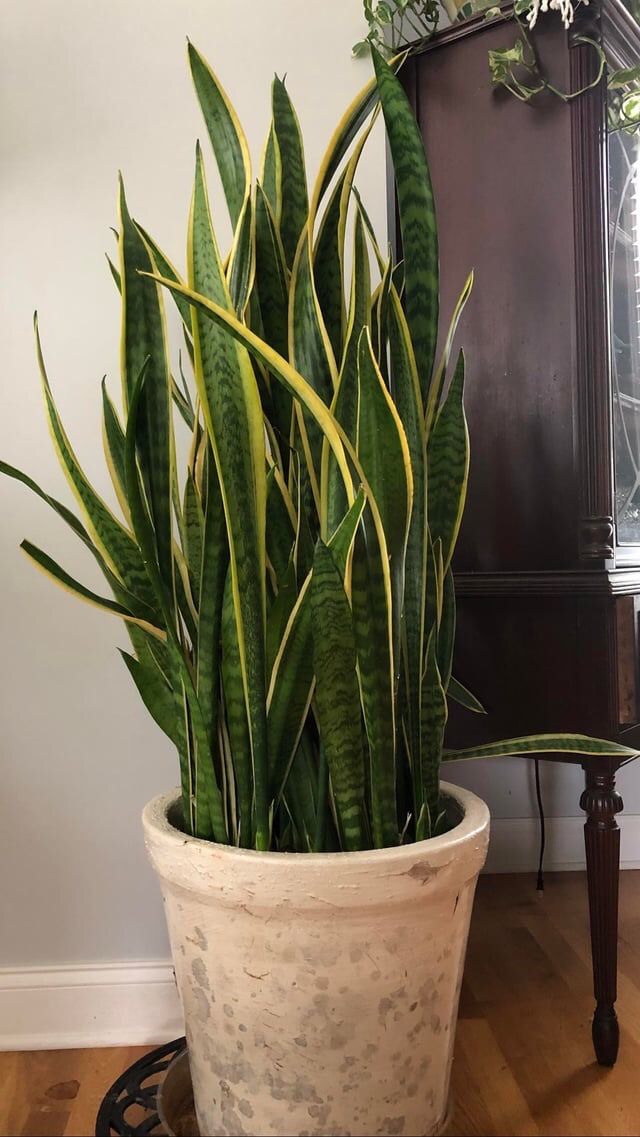
Snake plants are usually one thing or the other. Either very full and lush looking with extremely upright leaves or they’re looking a bit pathetic. They don’t seem to have much in between.
My first one was sadly a bit pathetic looking. It was pretty much impossible to kill, I’ll give it that, but it barely ever grew new leaves over a year. And me being a bit of a novice I just assumed that’s what snake plants were like.
Turns out that was wrong. A sparse snake plant is almost always one that’s been put somewhere too dark and then left alone. And once you sort that out it starts to grow and fill itself in.
Snake plants grow slowly so it won’t change overnight but the new pups and leaves do come if you give it what it likes/needs. And if you want a full looking plant today there’s a shortcut I’ll get to further down.
What a snake plant won’t do is get bushy on its own. Especially if you leave it sat in a dark corner and make the same sort of mistakes I was.
So this guide will show you how to get a snake plant that looks full and impressive both by the slow proper way and the quick cheat.
Quick Answer
- Give it Bright, Indirect Light: This is the biggest thing you can do. Snake plants only grow new pups and leaves when they get plenty of light. So move your as close to a bright window as you can without burning it.
- Leave the Pups Alone: The little shoots coming up around the base are how a snake plant gets fuller. Don’t separate them off to make new plants, let them fill the pot.
- Pot it Snug: Snake plants produce more pups when they’re a bit crowded. A pot that’s too bi will slows down how fast it’s growing and risks rot.
A Bit of Honesty About Bushy
So lets clear something up before we go any further. A snake plant doesn’t get bushy the way a spider plant or a pothos does. It won’t branch out when you cut it and it won’t sprout new stems along a vine. It doesn’t have any vines.
What a snake plant does instead is grow from an underground rhizome. That’s a sort of thick foot that grows under the soil and pushes up new leaves and plants (called pups).
A “full” snake plant is just a pot thats has lots of leaves and pups all coming off that growing rhizome. So when we talk about making yours bushier what we mean is getting it to produce more of those leaves and pups and keeping them all together so the pot looks dense and full.
Why that matters is because it has an influence one what you should be doing. If you’ve already had a look around for advice you’ll have found some telling you to prune your snake plant to make it fuller and that’s simply wrong. We’ll get to why later.
For now just know you want to be encouraging new growth from the rhizome and not undoing it.
Why Your Snake Plant Looks Sparse
If your snake plant looks thin or leggy it’s usually one of these reasons.
It’s Not Getting Enough Light
This was my problem for the longest time. Snake plants are sold or known as the plant you can stick in a dark corner and forget, and that’s true in the sense that they won’t die in low light.
But “won’t die” and “will grow into a full, impressive plant” are two very different things.
In low light a snake plant basically goes into standby mode. It holds onto the leaves it has and it stops bothering to make new ones.
No new leaves and no new pups means no extra fullness, ever. Mine barely changed in a year and I was working on the basis that snake plants were just like that. But in fact I had it in a spot that didn’t get enough light.
It’s Young or Was Grown From a Single Pup
A lot of snake plants sold cheap are a single division potted up on its own. So you’re starting with one small plant and it’s going to look a bit bare for a while no matter what you do.
That’s normal and it’s not a problem you’re going to be able to fix in a week. It fills in with time and the right conditions, which is most of what this article is about.
The Pot is Too Big
This always seem a bit counterintuitive. You’d want a big pot for a bigger plant, right?
Wrong. With most houseplants a bigger pot means more room to grow. But with a snake plant a pot that’s too big just means a lot of damp soil sitting around the roots with nothing to do.
The plant doesn’t try to fill in the space. Instead it just sits there and all that extra wet soil causes the roots to rot.
A tighter pot does the opposite. It makes the rhizome start pushing up pups.
It’s Naturally a Tall, Single Variety
Not every snake plant is built to look full. The classic tall Dracaena trifasciata grow upright leaves and can look a bit sparse.
If you really want a dense looking snake plant then the variety you start with matters a lot. More on that further down.
Even snake plants can be killed by accident.
They're tough, but they fail in specific, avoidable ways. My free guide 7 Gardening Mistakes That Are Killing Your Plants covers exactly what to watch for.
Light Changes Everything
If you only do one thing from this whole article that should be it. Light is what powers new growth in a snake plant.
More light means you’ll get more pups and leaves. Less light and the plant does very little.
Bright, indirect light is what they like. An east or west facing window is usually perfect. Putting the plant a few feet away from a bright south window works too.
You can give a snake plant some direct sun and it’ll be able to handle it but a few hours of sun hitting the leaves through glass in the afternoon can burn them. So slowly move it into any direct light instead of taking it from a dark corner and putting it in the sun overnight.
If you don’t have a spot that gets bright light then this is one of the few cases where a grow light is a good solution. A cheap clip on LED running a few hours a day will get noticeably more new growth over a season than a dim corner ever will. A small adjustable grow light like this one is enough for a single plant.

Give it a few months in better light before you decide nothing’s working. Snake plants don’t grow quickly.
But the difference between a snake plant in good light and one in dark or less light is surprising.
Leave the Pups Where They Are
When your snake plant finally starts pushing up little pups around the base you will be tempted to separate them off and pot them up as new plants. And you can absolutely do that if you want more plants.
But you can’t do that AND have a fuller original plant. It’s one or the other.
If you want it big and full then leave every pup right where it is. Each one that stays becomes another leaf or group of leaves that will fill out the pot.
Over a couple of seasons a single plant that’s left alone becomes much more dense and packed with growth. Every pup you pull off is a little bit of fullness lost.
So when you see any new shoots, don’t cut them away. Just keep feeding and watering and let them do their thing.
If you do want to propagate as well the it’s a good idea to wait until the pot is very full and then only divide off the excess. Here’s the full method when you get to that point: How to Propagate a Snake Plant: The Ultimate Guide.

Keep the Pot Snug
I mentioned this above but it’s worth its own section because it’s so counterintuitive.
Snake plants give you more pups when the rhizome is a bit crowded. A pot that’s got lots of roots and rhizome is a plant that starts looking for somewhere to put new growth, and the only direction it has is up, as new pups.
So resist that urge to keep moving yours into bigger and bigger pots. When you do repot it go up just one size, no more than that.
A lot of people kill the fullness of their snake plant with kindness. They put it in a giant pot thinking they’re being generous and then are left wondering why its sitting there in wet soil doing nothing for a year.
The only exception to this is when a plant is so root bound the pot is cracking or bulging or the soil dries out within a day of watering. At that point it does need more room.
Group Several Together
Everything above is the slow, proper way to do things and it works. But if you want a full snake plant today and you’re not the patient type then there’s a shortcut. It’s not cheating as it’s how a lot of the gorgeous full pots you see online are made.
You but two or three small snake plants, or take a plant you’ve divided and replant the divisions back together, and pot them all together in one container. You instantly get a dense and full pot instead of waiting two years for one plant to fill in.
As long as they’re the same variety and roughly the same height it looks completely natural and because snake plants are so slow and undemanding they’re happy to be jammed in together like that for years.
This is the trick to use if you’re selling a house, have an event coming up etc. If you don’t mind waiting a while then let one plant grow, if you want quick results then cluster them together. Most people end up doing a bit of both.

Feeding for More Growth
Snake plants barely need any feeding but if you’re trying to get more growth a little fertilizer in the growing season does help. The key word there though is little. These are plants that evolved in poor, dry soil so its easy to over do it right them.
A balanced houseplant fertilizer diluted to half strength, once a month through spring and summer, is more than enough. A gentle balanced feed like this works fine
 Miracle-Gro Indoor Plant Food for All Plants, 8 fl. oz. (2-Pack)
Stop feeding them at all in fall and winter when the plant will naturally be slowing down. Feeding a dormant snake plant just builds up salts in the soil that burn the roots and tips of the leaves.
Watering Without Stopping the Growth
Watering is where most snake plants get hurt. A hurt snake plant won’t make any new pups as it will just be trying to survive. Overwatering is the big one.
Snake plants store water in their leaves so they’re able to cope with droughts far better than too much water. Sitting in wet soil will result in root rot and root rot means no new growth at best and a dead plant at worst.
The rule is simple. Let the soil dry out almost completely then water thoroughly until it runs out of the drainage holes, then leave it alone again it’s dry.
In practice that’s usually every two to three weeks in the summer and once a month or less in winter. But don’t get in to the habit of watering on a schedule, just water on the soil.
Stick a finger in. If there’s any damp down there, wait. If your plant’s leaves are starting to wrinkle or curl that can be a sign it’s gone too dry for too long, the opposite problem.
There’s a full rundown here: 9 Reasons Your Snake Plant Leaves Are Curling.
Warmth Helps Too
Snake plants are tropical plants and they grow fastest when they’re warm. Normal room temperature is ideal, roughly 65 to 85 degrees.
They more or less stop growing below about 50 and any cold drafts or a very cold windowsill will stop them too. So if your plant goes dormant every winter that’s normal and the new growth you’re after will come back when things get warmer in the spring.
It doesn’t matter what you do – a snake plant isn’t going to fill out in the middle of January.
Pick a Clumping Variety
If you’re buying a new snake plant specifically because you want the dense look then the variety you pick is important.
- Bird’s Nest types (Sansevieria ‘Hahnii’ and ‘Golden Hahnii’): These stay short and grow in rosettes that look full. If you want bushy without having to wait this is the one.
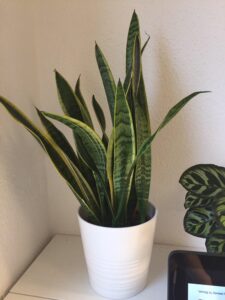
- Standard Dracaena trifasciata (‘Laurentii’ and similar): The classic tall variety. It can look full once it’s got lots of pups but it takes longer and it has that upright shape rather than a dense mound.
- Cylindrica (the round-leaved one): Looks striking but is generally has a more sparse look. Its lovely but not the variety to pick if you want a very full plant.
You can’t change the variety you already own but if you’re combining plants for the cluster trick then choosing a naturally fuller variety like Hahnii will help to make it work.
Why Pruning Won’t Make it Bushier
Now the myth I promised to deal with. You’ll find lots of advice telling you to prune your snake plant to encourage bushier growth, the same way you’d pinch out a pothos or trim a spider plant.
Don’t. It doesn’t work the same way and you’ll just end up with a smaller plant.
When you cut a snake plant leaf that leaf does not branch or regrow from the cut. It won’t do anything in fact and just becomes as a shortened leaf with a flat cut top, looking pretty strange.
New growth on a snake plant only ever comes up from the rhizome, never from a cut on an existing leaf. So cutting leaves back removes any fullness you’ve already got and it doesn’t add it.
The only good reason to cut a snake plant leaf is to remove one that’s damaged, rotting, badly scarred or bent over for good. In that case take the whole leaf off right down at the soil rather than trimming the top.
Tidying up the odd ruined leaf is fine and to be encouraged. Pruning as a way to get fullness is not going to work.
How Long Does This Take?
You’re going to have to be patient. Snake plants are some of the slowest houseplants there are.
In good light with the right care you might see a new pup or leaf every few weeks through the spring and summer and a sparse single plant becoming a full pot is going to take more like a year to two year than a few months.
If you want your plant fuller sooner than that then the clustering trick from earlier is the way to go. Combine the slow, proper care with a few plants potted together and you get the best of both worlds – a full look now that keeps getting fuller over time.
Mistakes I Made
- Kept it in a dark corner for over a year. Because I was told me snake plants love low light. It survived but it also did nothing more. Moving it near a bright window was what finally got it growing.
- Separated every pup the second it appeared. I was so pleased to be getting free plants that I kept pulling the pups off then couldn’t work out why my original plant stayed so thin. I was harvesting the growth I wanted to keep.
- Repotted it into a huge pot. All that gave me was wet soil and no new growth.
- Watered it like a normal houseplant. Every week, on a schedule, without checking. Nearly caused it to rot. Now I just let it dry out and it’s much happier.
- Cut the tops off a couple of leaves to shape it. I wish someone had told me they don’t grow back from a cut. I just had two stubby leaves for ages.
What to Do Now
- Move your snake plant to the brightest spot you’ve got that isn’t direct sun. Do this first as it matters the most.
- Stop pulling off the pups. Let them fill the pot.
- Check the pot size. If it’s in a too big container move it down in size to something more snug next time you repot it.
- Ease off the watering. Let it dry out fully between.
- If you want it to be full now the get a couple more of the same variety and pot them together.
Do those and give it a growing season. A snake plant that was sitting around doing nothing will start putting up new growth, and over time that’s what fills the pot.
Final Thoughts
To get a bushy snake plant you don’t nee to follow any secret tricks or do some clever pruning. Its mostly about giving it enough light and then leaving the pups alone and not drowning it.
Do that and it slowly grows into the full plant you were picturing. And if you’re impatient like me a few plants potted together will get you there in an afternoon.
Even snake plants can be killed by accident.
They're tough, but they fail in specific, avoidable ways. My free guide 7 Gardening Mistakes That Are Killing Your Plants covers exactly what to watch for.
