
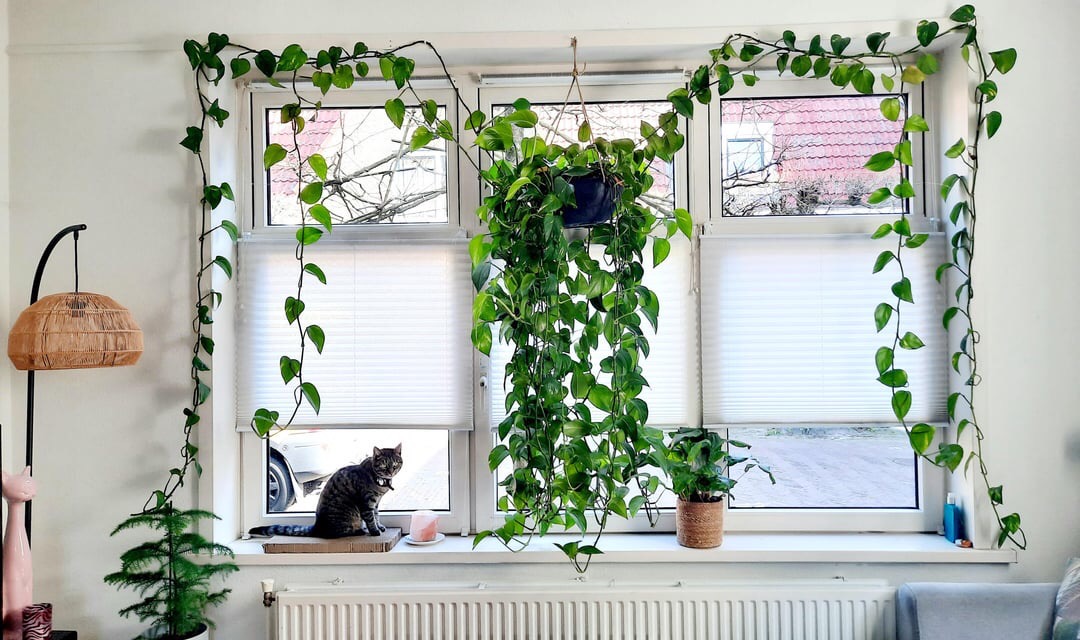
When I first tried to get my pothos to climb I just shoved a moss pole in the soil with it and hoped for the best. You’ll be shocked to learn it didn’t work.
The vines just sort of hung there, looking at me like I was an idiot. And you know what? They were right.
But little did I know that getting a pothos to climb isn’t all that complicated once you understand what they like and want. I’ve spent the last few years experimenting with different methods, making plenty of mistakes along the way and I’ve figured out what works and what very much doesn’t.
So if you’re tired of your pothos trailing all over the place (or worse – getting leggy) I’ll take you through the tricks that will make a difference.
Quick Answer
- Add a Support: Use a moss pole, trellis or stake so vines have something to grab onto.
- Guide and Attach Vines: Tie the stems to the support using with ties or clips to train it to go grow up.
- Increase Light: Bright, indirect light will help to get stronger climbing growth instead of trailing.
Why Bother Making Your Pothos Climb Anyway?
Before we get into the how its useful to take a second to look at why you want to it pothos to climb.
In their natural habitat pothos are climbers. They’re not supposed to be trailing plants – that’s just what happens when we stick them in hanging baskets.
In the wild they would climb up trees in tropical forests, attaching themselves with aerial roots and reaching for the light.
In fact when pothos climb their leaves can grow up to three times larger than when they trail. And three times is a massive difference.
I noticed this when I got my climbing setup right. The new leaves coming in were absolutely huge compared to the little ones from before.
And a climbing pothos just looks better. There’s something about how it grows that makes it feel like a something out of a jungle instead of just another houseplant.
Understanding How Pothos Climb
This is where most people (including me in the past) get it wrong. Pothos don’t climb like ivy, for example. They don’t have tendrils that wrap around things.
What they have is small aerial roots that grow along the stem and these roots want to grab onto something that’s got some texture and is a bit moist.
I tried using a smooth bamboo stake for my pothos. It really didn’t like it and just slid right down. The aerial roots need something they can properly grip on to. So that means something with texture and thats like tree bark.
The other thing to know is that pothos will climb if given the chance. Make it easy and beneficial for them and they’ll do it but if you just expect them to figure it out on their own you’ll be waiting a long time. You need to give them a reason to climb and make it as easy as possible for them.

The Classic Moss Pole Method

For most people moss poles are they best way to bet pothos climbing, and there’s a good reason for that – they work. But only if you use them the right way.
If you think you can just stick a dry moss pole in the pot and expect it to start climbing, well, you’re wrong. The moss needs to stay moist because the aerial roots on your plant are looking for moisture.
When I finally started misting my moss pole every few days there was a big change. The roots begun to attach themselves and the plant began climbing on its own.
You’ve got a few options for moss poles:
- Sphagnum moss poles (the traditional choice – these work great but dry out quickly)
- Coir poles (made from coconut fiber – I prefer these because they hold on to moisture better)
- DIY options using PVC pipe wrapped in moss or burlap

What you want to do is put the pole in before your pothos gets too big. I waited until my plant was already huge before doing so and then I had to go through a whole awkward situation of trying to get the pole in without damaging the roots. Which is not a lot of fun. So do it early – you’ll be glad you did!
Also don’t be shy about tying the vines to the pole. Use soft plant ties or even strips of old t shirts. Once the aerial roots make contact with the moist moss they’ll attach on their own but they need a little help getting started. I usually tie mine loosely every 4 to 6 inches up the stem.
The Plank Method
This is going to sound weird but believe me – wooden planks work really well for pothos.
I discovered this kind of by accident when I was reorganizing my plant shelves and propped a pothos against a piece of cedar board. It only took a couple of weeks and the aerial roots had latched on so tightly I couldn’t pull the plant off without damaging it.
The texture of wood is apparently ideal for pothos aerial roots. It looks pretty cool too – kind of like the plant is growing on a little piece of tree.
If you wanted to do the same thing I set it up like this:
Get a piece of untreated wood (cedar, pine etc. – just make sure it’s not treated with chemicals). You want it maybe 1 to 2 inches thick and however tall you want your plant to grow. Rough it up a bit with sandpaper if it’s too smooth. Then either stick it in the pot or mount it on the wall behind your plant.
The wooden plank method has a few advantages over moss poles. For one you don’t have to worry about keeping it moist constantly – the wood holds onto water well enough on its own when you water the plant.
And two, it’s way cheaper. A moss pole can cost you $20 to 30 but a piece of wood from the hardware store will only cost maybe $5.
The downside? It’s heavier and more permanent. You can’t really move it around once the plant attaches to it.
Trellis and Wire Solutions for Bigger Spaces

If you’ve got a bigger space to work with – like you want your pothos to climb an entire wall or corner – then trellis will be the best option for you.
I set this up in my living room corner about a year ago and it looks incredible. All I did was mount a simple wooden trellis (the kind you’d use for climbing plants outdoors) on to the wall and then trained my pothos to grow across it.
You have to use plant clips or ties to secure the vines to the trellis as they grow. The pothos won’t naturally wrap around the trellis like some vines do so you have to guide them. But once you get a it going the plant starts to fill in on its own.
Some people use fishing line or wire grids instead of the usual trellises which also works great. It becomes invisible and the pothos just looks like it’s climbing the wall all by itself. I haven’t tried it myself but I’ve seen it done and it looks really modern and cool.
One thing to watch out for: make sure whatever you’re mounting to the wall is secure. A mature climbing pothos gets heavy.
We’re talking up to 20 to 30 pounds or more. That’s not something you want crashing down in the middle of the night.

Using Command Hooks

This one is great for renters or anyone who doesn’t want to put holes in their walls.
I’ve used clear Command hooks in the past and then I hang the pothos vines over them as the plant grows. It’s not true climbing in the sense that the aerial roots aren’t attaching to anything but you’ll get the same effect.
You’ve got to make sure you use enough hooks that the weight is distributed properly though. I usually put them every 8 to 10 inches going up. And I use the kind that can hold at least 3 pounds each just to be safe.
This works best for younger and lighter pothos. Once the plant gets older and heavier you might need to change to something thats stronger. But for getting started it’s a great solution.

Training Techniques
Alright, so you’ve got your support structure in place. Now what?
This is where patience comes in, which can be annoying if you’re keen to get going. But there are some things you can do to speed up the process.
- Choose the right vines: Vines aren’t all the same. So pick the longest, healthiest vines to train. The ones with aerial roots you can see are your best bet because they’re already ready to grab onto something.
- Secure the vines loosely but firmly: When you tie the vines to your support make sure they’re touching the surface but not being held on too tight. I use velcro plant ties because you can adjust them and it won’t cut into the stems.
- Mist often: If you’re using a moss pole or anything similar then keep it moist. I mist mine every 2 to 3 days. This will get the aerial roots to grab on instead of just sitting there.
- Be gentle: Pothos stems can be fragile and a bit brittle, especially older parts. Don’t force them where they don’t want to go. If a vine is growing in the wrong direction it’s sometimes easier to just redirect any new growth instead of trying to bend old growth.
- Trimming: This is counterintuitive but sometimes you need to prune some to get more growth. If you’ve got vines growing in every direction then trim the ones that aren’t doing what you want. This will focus the plant’s energy on the vines you’re training to grow up.
One thing I’ve figured out through some trial and error: pothos will follow where the light is coming from. If the source of light is above the plant (like a skylight or high window) the plant will want to climb toward it. But if your light is at the same level as the plant you might find it keeps trying to grow out instead of up. You can work with this by using a grow light put somewhere above your support.
For more help see our 15 tips to help your pothos grow.
Dealing with Stubborn Vines
Sometimes no matter what you do there are some vines that just won’t play ball. They hang down, grow off to the side and do everything except climb up the support you’ve setup for them.
It’s frustrating.
What you can do though is propagate your plant. Cut off the trailing vines that aren’t doing what you want, propagate them in water for a couple weeks until they have nice roots and then plant them at the base of your moss pole or support. These fresh cuttings often take to climbing much better than old growth that’s been trailing for months or years.
Pothos propagate really easily. Plus you end up with a fuller plant at the base, which looks better anyway.
The Moisture Trick
This is something I figured out completely by accident but it’s made a huge difference: bottom watering as well as keeping your support moist creates this something that pothos seem to love.
What I do is water my climbing pothos from the bottom (stick the whole pot in a tray of water and let it soak up what it needs). This keeps the soil moist without overwatering it. Then separately I mist or water the moss pole or wooden plank from the top.
What happens is the aerial roots sense moisture in the soil and in the support and they start growing toward the pole.
I didn’t believe it would make that much difference until I tried it. But after a couple of weeks I had aerial roots reaching out toward the moss pole. Before that they weren’t doing a lot.

Mistakes to Avoid
Using smooth supports: Anything smooth like plastic stakes or metal poles that the aerial roots can’t grip on to. It’ll be a total waste of your time.
Setting it up and forgetting it: Climbing pothos need maintenance. You have to keep tying new growth, keep the support moist and keep an eye on things. You can’t set it and leave it.
Expecting instant results: This is a slow process. It took my pothos about three months before it really started climbing on its own. If you’re checking every day expecting a big and noticeable change you’re going to be disappointed.
Not providing enough light: A pothos will climb much better when it’s getting the right amount of light. If your plant is in a dark corner it’s going to put its energy into surviving, not climbing. Give it at least medium indirect light and you’ll get much better results.
Forcing old growth: Like I mentioned before older vines that have been trailing for a long time are harder to make do what you want. It’s usually easier to work with newer growth or cuttings.
How to Make It Look Good
This is the fun part. Once you’ve got your pothos climbing how do you make it look good and not just like a plant growing wild?
I like to create a balanced look by training vines in a somewhat symmetrical pattern. Not perfectly symmetrical, because that looks weird, but balanced enough that it doesn’t look lopsided. I’ll train vines up and slightly out, creating a sort of fan shape.
Some people go for the full jungle wall where they let the pothos completely cover their support and even grow beyond it. That’s cool too but it needs a lot more maintenance to keep it from getting out of control. And I can’t really be bothered with all that!
Another approach I’ve seen that looks really good is the spiral method – you train the vines to spiral around a moss pole as they climb. It takes more effort to maintain but the result is pretty awesome looking.
Whatever look you’re going for remember that you can always prune. Don’t be afraid to cut back vines that aren’t helping with the shape you want. The plant will thank you for it with more growth elsewhere.
If you want some more inspiration see our creative and easy pothos climbing ideas.
Care for Climbing Pothos
Once you’ve got your pothos climbing how you care for it shifts a bit. You need to think about the height -as your plant climbs higher those top leaves are farther from the source of water and might need some extra attention.
I deal with this by occasionally misting the entire plant not just the support. During the dry winter months especially this seems to help keep the upper leaves from getting crispy.
You’ll also need to think about repotting eventually. A climbing pothos gets bigger roots than a trailing one. I repot mine every 2 to 3 years into a slightly larger pot. The tricky part is doing this without disturbing the climbing setup which is why I’m a big fan of supports that go deep into the pot as they stay stable during repotting.
Fertilizing is important too. I use a balanced liquid fertilizer diluted to half strength every 4 to 6 weeks during the growing season. Climbing takes energy and a well fed pothos climbs better than one that’s struggling.
Final Thoughts
Getting a pothos to climb isn’t really that hard but it does need you to understand what the plant needs and being willing to put in some effort. It’s not something you can be passive with – you have to stay involved, keep changing things and up working with the plant.
But it’s definitely worth it. When you get your plant that was once just trailing over the edge of a pot to become a huge climbing specimen with enormous leaves it feels great.
What you’ve got to remember is to give it something textured to grab onto, keep it moist, secure the vines until they attach on their own and then it’s just about being patient. Do all that and your pothos will eventually climb.
And don’t forget you can just propagate and start fresh if you mess anything up. That’s what’s so great about pothos – they’re forgiving plants. They’ll let you experiment and make mistakes and they’ll keep growing no matter what. They just might need a little help figuring out which direction to grow in.
