
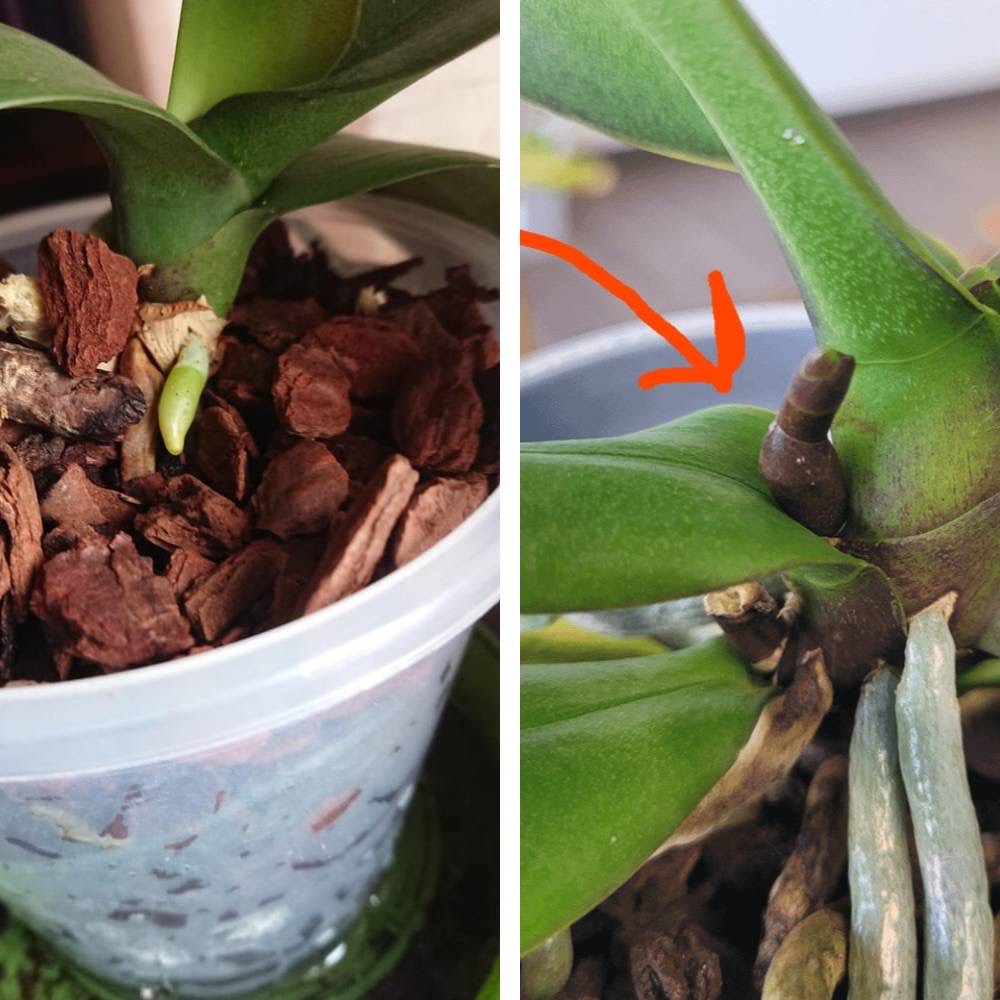
Its always exciting when you notice some new growth on your orchid. When you see something coming from the base of the plant, or from a node on the stem or just pushing up through the bark it’s a real thrill. And of course you want to know what it is.
Is it a flower spike – the beginning of the bloom you’ve been waiting months for – or is it a new root?
That question matters because how you react to each of them is different. A developing flower spike needs support, stability and maybe a little adjustment to encourage it to flower.
A new root needs to be left alone. You don’t want to stake it, redirect it into the pot, and definitely don’t confuse it for a spike and accidentally damage it.
Getting this wrong in the early stages, when the new growth is small, is a mistake a lot of people make and it will have consequences as to whether your orchid flowers or not.
Don’t be too worried though as when you know what to look for it’s easy to distinguish them from one another. And that’s what this guide will do. I’ll take you through how to identification both, looking at the shape, colour, texture, tip characteristics, direction of growth and where on the plant new growth appears – for both roots and spikes across all the commonly grown orchid genera.
It also covers the third possibility that sometimes surprises people: a keiki, which is neither a root nor a spike but a baby plantlet. And I’ll make sure to show you what to do once you have made your identification.
Quick Answer
- Root Tips Are Round (Most Common): New roots have smooth, rounded green or silver tips and usually grow down or out.
- Spike Tips Are Pointed: New flower spikes have flatter tips that are shaped like mittens and often grow upward between the leaves.
- Watch the Growth Direction: Roots search for moisture, while spikes stay upright and grow towards the light.
For more help see 7 Mistakes You’re Making with Your Orchids (And How to Fix Them).
Why This Is Harder Than It Should Be
At a certain stage of development a new orchid root and a new orchid spike look very similar. Both emerge as small, pale, pointed growths.
Both can appear from the base of the plant or from nodes along a stem. Both are soft and fleshy when they’re young.
For the first week or two of growth the differences are subtle enough that even those of us who have grown a lot of orchids can struggle to tell the difference. At that point the best advice is to just wait.
The confusion is made even worse by the fact that the features that are most likely to set apart roots from spikes – the shape of the tip, the branching pattern, having scale-like bracts – only become something you’ll see as they grow.
In the very early stage the honest answer is sometimes that you cannot yet tell with certainty and the right thing to do nothing. Just watch and wait for another week or two. Patience at this stage is not a problem and is in fact the right decision.
That said there are some features you’ll see even in early stages that will be a good indicator of one or the other. And there are features that become definitive within two to three weeks. Working through them gives you the best chance of identifying correctly early on.
The Identifying Features: Root vs. Spike
Tip Shape: The Best Early Indicator
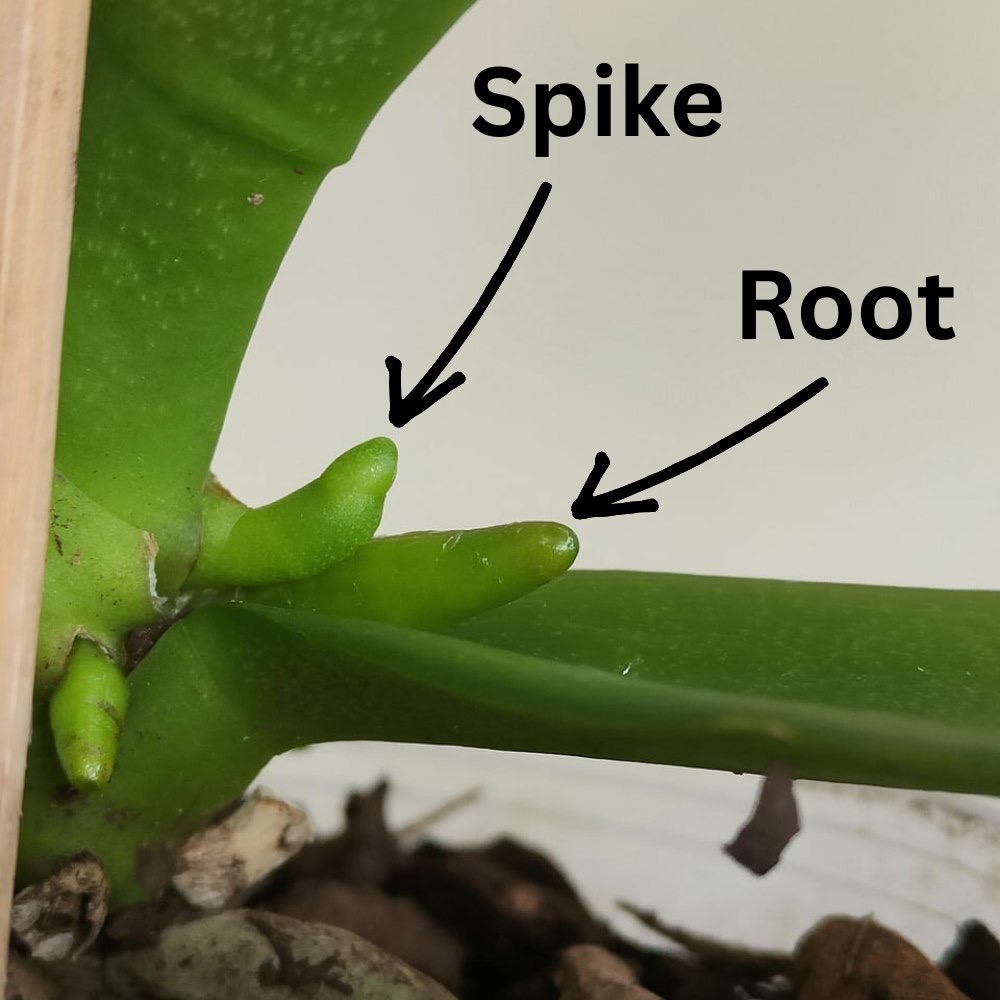
The tip of new growth is the single best way to identify whether it’s a root or nee spike and it is visible even on relatively young growth.
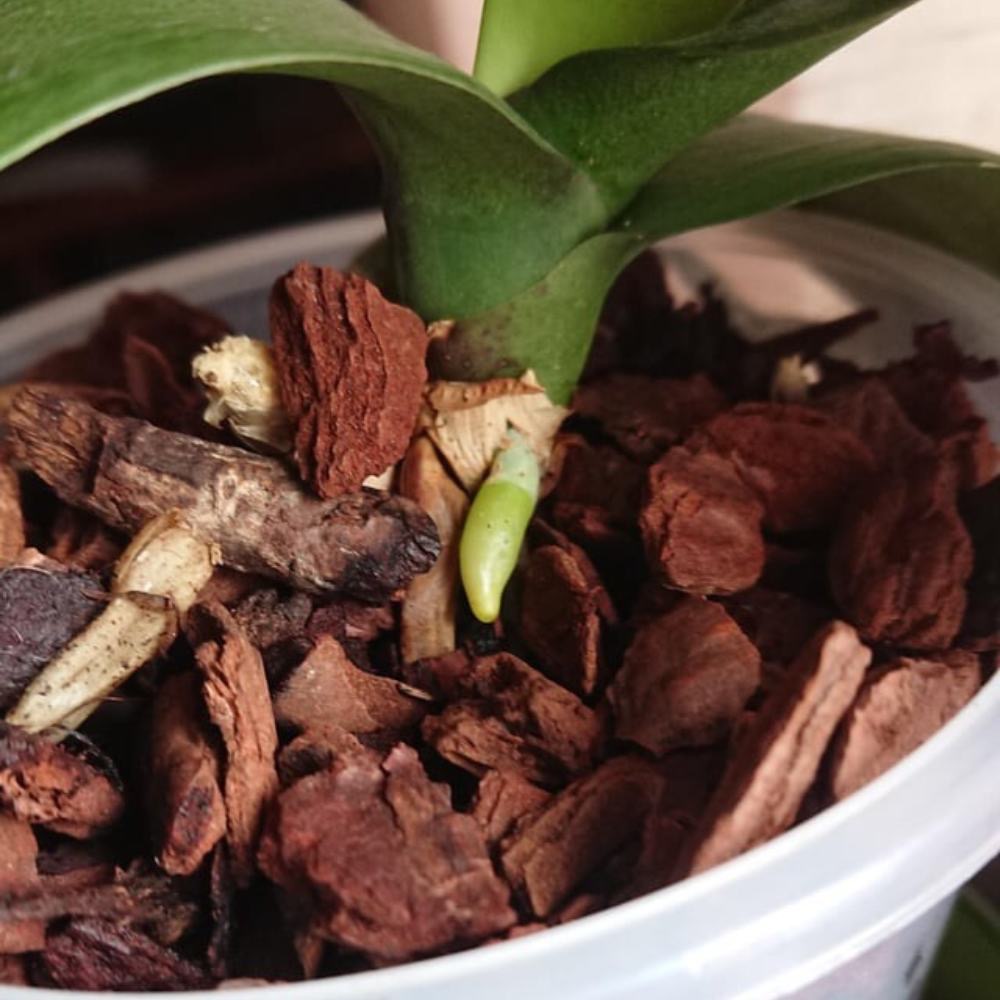
A new root tip is smooth, rounded and blunt – almost like the end of a pencil eraser. In good growing conditions with decent humidity the root tip is bright green – this is the part of the root that’s growing and will photosynthesize.
In drier conditions or lower humidity the tip may be a paler and a more muted green but it stays smooth, rounded and blunt.
A new spike tip is pointed – properly pointed and not rounded. The tip has a a bit of a fold or crease down the centre which makes it look flattened and folded and not the smooth, uniform surface of a root tip.
When you look closely at the spike tip it has a subtle texture – slightly ridged or pleated. This folded, pointed tip is the best early indicator of a spike.<
Tip shape at a glance:
- Rounded, smooth, blunt, uniform: Root
- Pointed, folded, slightly flattened, ridged or pleated: Spike
Color
Color is also useful but not definitive on its own because it varies with the growing conditions, variety and the age of the growth.
New root tips are characteristically bright green when they’re actively growing in good conditions – the velamen (that’s the spongy outer layer of orchid roots) is silver/white or grey when dry and the growing tip, which has thinner velamen, shows as a green point.
In lower humidity or when the root is not in active growth the tip may be paler green or even slightly grey. The rest of the new root – the section behind the tip – is usually white or silver, sometimes with a slight green tinge when it’s in very humid conditions.
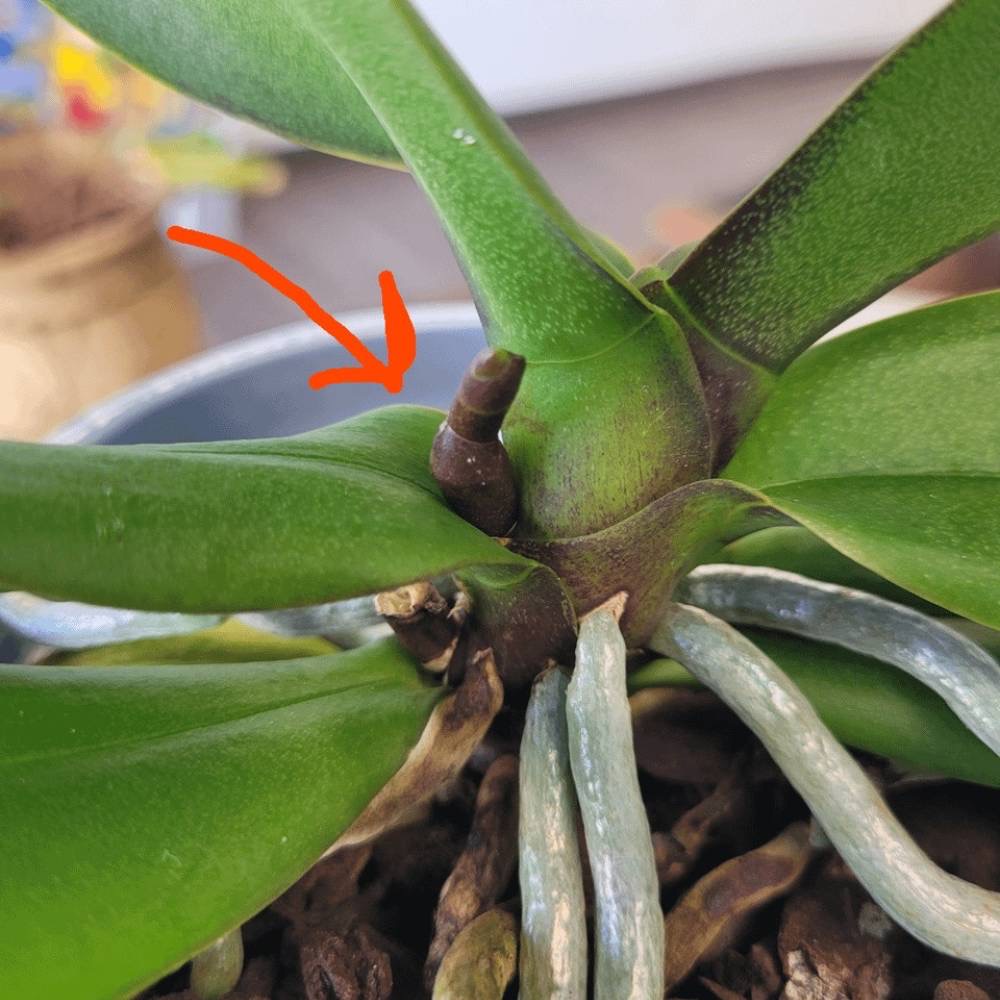
New spike tips are typically green but they are a duller, more muted shade than the green of a root tip. Some spikes grow out with a reddish, burgundy or brownish tinge at the tip – this is especially seen in Phalaenopsis and varies by variety.
The reddish coloring at the tip of an emerging growth is a pretty reliable indicator of a spike rather than a root because root tips do not usually show this reddish color. If the new growth tip has any red, purple or maroon in it its almost certainly a spike.
Color as a clue:
- Vivid bright green tip, white or silver behind: Root
- Duller green tip, sometimes with reddish, burgundy or maroon tinge: Strongly suggests spike
- Pure white or silvery throughout: Root that is not in active growth or is in low humidity
Direction of Growth
The direction in which a new growth is going in is one of the most practical features that can help you identify which is. It’s also one of the most reliable once the growth is long enough to show exactly which direction it’s going in.
New roots grow out and then down. They start by growing away from the plant horizontally or at an angle going down, looking for the nearest growing medium or surface to anchor to.
Aerial roots (those growing outside the pot) grow out into open air and then curve down. Roots growing within the pot push through the growing medium toward when the water drains at the base. The direction is always out and eventually down.
New flower spikes grow up. They emerge pointing up or at an upward angle and keep that trajectory as they grow. A growth that is clearly heading up from the base of the plant or from a node on the stem, going in an arc rather than curving out and down is almost certainly a spike.
This upward direction is very reliable in Phalaenopsis where the spikes always grow from nodes on the stem between the leaves and grow toward the light.
The exception to the direction rule: Some Phalaenopsis spikes initially emerge growing out or even slightly down before they curve up as they develop. The plant’s phototropic response eventually turns the spike toward light. Do not rule out a spike solely because the very early growth is not pointing straight up. The tip shape and colour are definitely more reliable than direction in the earliest stage.
Where on the Plant New Growth Appears
The location of new growth on the plant is a useful clue, though not a definitive one because both roots and spikes can appear from the sort of spots.
In Phalaenopsis flower spikes emerge from the nodes – the slightly raised points on the stem between the leaves and generally from the lower to middle nodes of a mature plant.
Roots can also grow from the stem at or near nodes, as well as from the base of the plant and from aerial spots along the stem. So where nodes grow from alone does not confirm a spike but a growth emerging specifically from a node in the middle section of a Phalaenopsis stem is more likely to be a spike than a root.
Roots generally grow from the base of the plant, from the lower portion of the stem below the lowest leaf and as aerial roots from lots of points along the stem. A growth emerging from the very base of the plant, below the lowest leaf, is more likely to be a root than a spike. A growth emerging from a node clearly between two leaves in the middle of the stem is more likely to be a spike.
Texture and Surface
As the growth develops beyond its first week the texture on the surface will get more and more easy to distinguish between roots and spikes.
The surface of a root is smooth – the velamen has a clean and waxy look that is completely smooth along its length. There is nothing on the surface of a root other than the occasional small bump at the point where a root might branch.
The surface of a spike is covered in small bracts – which are tiny structures that look like leaves and wrap around the spike at points as it grows. These bracts you can see as slightly raised, overlapping points along the length of the spike and they become more distinct as the spike gets longer.
Running your finger along the length of a growth that is a centimetre or more long you can feel the smooth surface of a root versus the slightly bumpy, bracted surface of a spike. This difference becomes more and more clear as both types of growth develop.
Rate and Pattern of Growth
Roots and spikes grow at different rates and in different patterns once they’re established.
Roots grow fairly continuously and at a consistent rate. A new root will grow at a roughly steady rate, its tip moving through the growing medium or air, with the root behind it remaining smooth and unchanged. The speed depends on the conditions but the pattern of its growth will be in a straight line and continuous.
Spikes often grow in bursts with periods of rapid growth and then longer pauses. They also develop a quite complex structure as they grow.
You will be able to see the nodes and bracts along the length and eventually branching occurs as the spike develops secondary branches. A growth that develops nodes and begins to branch is definitively a spike.

The Complete Comparison Table
| Feature | New Root | New Spike |
|---|---|---|
| Tip shape | Rounded, smooth, blunt | Pointed, folded, slightly flattened |
| Tip colour | Vivid bright green (active) or pale/silver (dormant) | Duller green, often with reddish or burgundy tinge |
| Direction | Out then down | Upward |
| Surface | Smooth, uniform, waxy | Small bracts at intervals |
| Growth pattern | Continuous straight growth | Bursts of growth, develops nodes and branching |
| Location on plant | Base, lower stem, aerial along stem | Nodes between leaves, lower to middle of the stem |
| Branching | No – grows as single strand | Yes – develops secondary branches carrying buds |
| Final structure | Long, smooth, single strand | Branched stem carrying buds then flowers |
The Third Possibility: A Keiki
New orchid growth is not always either a root or a spike. There is a third possibility.
A keiki (pronounced KAY-kee, from the Hawaiian word for child or baby) is a plantlet that grows from a node on the flower spike or, occasionally, from the base of the plant. It is a miniature clone of the parent plant coming with its own leaves and, eventually, its own roots.
Keikis are most common in Phalaenopsis that have grown in higher than usual temperatures during their flowering period or occasionally in reaction to hormonal fluctuations. They appear as a tightly packed bracts at a node on the spike – at first looking a but like a spike node with extra activity – that eventually resolves into small leaf like structures. Within a few weeks the tiny leaves of the keiki are unmistakable and within a few months the keiki will develops its own roots.
A keiki can be left in place until it has developed at least three leaves and some roots of its own (usually 2 to 5cm long). At this point it can be separated from the parent spike and potted into its own small container of orchid bark mix.
A keiki removed too early – before it has its own full roots – often fails to establish as an independent plant. Leave it attached to the parent plant until it’s definitely able to survive on it’s own.
Notes on Other Orchid Genera
What we’ve been through above applies most specifically to Phalaenopsis, which is by far the most commonly grown orchid. The same principles broadly apply to other genera too but there are some useful genus specific points worth knowing.
Cattleya and Allied Genera
In Cattleya, Laelia, Brassavola and their hybrids, new growth takes a different form from Phalaenopsis. New vegetative growth comes through as a new pseudobulb shoot from the base of the plant – a rounded, wrapped growth that will eventually develop into a full pseudobulb.
This is neither a spike nor a root but new vegetative growth. Flower spikes in Cattleya grow from a sheath at the top of a mature pseudobulb. That’s a sort of papery tube that wraps around the developing spike before it emerges.
New roots grow from the base of the plant or from the rhizome. The distinction between root and vegetative shoot is more relevant in Cattleya than root versus spike because when the spike emerges it’s very distinctive in its sheathed form.
Dendrobium
Debdrobium produces new growth as new canes (pseudobulbs) coming from the base of the plant. These canes grow up and look nothing like flower spikes. They come from nodes along the length of mature canes in a quite different form.
New roots emerge from the base of canes and from the rhizome. In Dendrobium new cane growth versus new root is better way to differentiate them and the difference is pretty clear once you know what to look for: a new cane grows up from a rhizome and is flat on the sides and very obviously leafy as it develops. A root grows out and down and remains smooth and unbranched.
Oncidium Alliance
Similar to Cattleya in that new vegetative growth appears as a new pseudobulb shoot from the rhizome base. Flower spikes groe from the base of a mature pseudobulb, usually as a green or reddish stem that stretches quickly and branches a lot to carry the small flowers characteristic of the group.
New spikes in Oncidium alliance genera can grow very quickly and the branching becomes obvious within a few weeks, making the spike identification straightforward once it is growing actively.
Vanda
Vanda orchids grow monopodially – they produce a single central stem that grows up indefinitely, producing leaves alternately on each side. Flower spikes grow from the stem between leaf axils (the points where leaves join the stem), growing out and up.
New aerial roots emerge from the stem and dangle down in a very Vanda way. The spike vs. root in Vanda follows the same general principles as Phalaenopsis – upward growth with pointed tip from a leaf is likely a spike; outward then downward growth with a rounded green tip is a root.
When You Can’t Tell Yet
There will be times, particularly in the first five to seven days of new growth, when you just can’t be certain which you are looking at. The growth is too small, the tip shape not fully formed and the direction has not yet established itself.
In this situation the best thing to do is nothing and simply wait. Do not stake the growth as staking a root does nothing useful and can damage it.
Do not try to redirect it into the pot or push it away from the pot. Frankly you shouldn’t do anything at all except continue with normal care and keep a watch on it.
Check every few days. Within one to two weeks the distinguishing features will have developed enough that you can make a confident identification.
The features that will show themselves earliest are the shape of the top (look for the fold and point of a spike tip versus the smooth bluntness of a root) and the color (any reddish tinge strongly suggests a spike). The direction, bracts and branching all become definitive with more time.
If you are checking the tip shape and it its smooth and rounded you are looking at a root. If you can see a fold – even a subtle one – in the tip, wait another week and look again. That fold, as it develops, will tell you everything.
What to Do Once You Have Identified the Growth
If It Is a Root: Leave It Alone
New roots growing is a sign of a healthy plant and doesn’t need any sort of intervention. Do not try to push aerial roots back into the pot as this will damage them and the roots adapted to aerial conditions do not function well when forced into a growing medium.
Do not stake a root either. Don’t cut a root that is growing in direction that’s inconvenient or doesn’t look good unless it is dead or rotten.
What you should do: keep giving it appropriate water and light that support the roots. A plant actively producing new roots is in good health and growing well — the best response is to keep those conditions that are producing that growth.
If the root is aerial and the tip is bright green then the plant is absorbing moisture through that root tip. Misting aerial roots occasionally or making sure the growing medium stays appropriately moist gives the root the conditions it needs to continue developing.
If It Is a Spike: Support and Encourage
A developing flower spike is one of the most exciting things you can see on your orchid. There are a quite a few things you can do to support it toward becoming a successful bloom.
- Do not move the plant. Once a flower spike has begun to develop the plant has got the spike pointed towards the available light. Moving it changes that orientation and can cause the spike to twist awkwardly or, in some cases, abort completely. Choose a stable position for a spiking orchid and leave it there until it’s done flowering.
- Stake as the spike grows. Once the spike is 10 to 15cm long, give it a bamboo stake and ties or orchid clips to support it in an upright or outward position. Stake it loosely – the spike needs room to adjust its position as it grows and the buds develop. Never force a spike into a position it is not naturally heading toward.
- Maintain consistent watering and feeding. A developing spike takes a lot of energy. Continue to feed it regularly with a high phosphorus bloom fertiliser (switching from the balanced or nitrogen forward feed if you have been using one) to support the bud development. Do not let the plant dry out completely as the spike develops. Consistent moisture supports the energy demand of producing flowers.
- Avoid drafts, cold temperatures and ethylene gas. All three can cause bud blast where the buds drop before they open. Keep the plant away from drafty windows, fruit bowls (ripening fruit gives off ethylene) and any vents that push our hot or cold air. Keep the temperature at above 15 degrees Celsius consistently.
- Be patient. From when the first spike appears to the first open flower it usually takes eight to twelve weeks in Phalaenopsis. The spike grows, buds develop and swell and then the lowest bud on the spike opens first, with subsequent buds opening progressively upward. The wait is long and there will be a temptation to move, adjust or intervene. Resist it. Stability is what the plant needs most once a spike is developing.
t
I spent two years not being sure what was a root and what was a spike whenever new growth appeared on my Phalaenopsis. I staked lots of the roots, which did nothing, and I failed to stake one spike early enough, which ended up so tangled with the plant’s leaves that the flowers opened at an awkward angle.
Once I learned to look for the pointed, folded tip versus the smooth rounded tip and to wait if I was not certain I found myself almost automatically being able to distinguish between the two very quickly.
The folded tip of a spike, once you have seen it, is unmistakable and it makes the wait for flowers much less anxious because you know what you are waiting for.
